
This article is all about designing and operating a profitable coupon marketing strategy. You’ll learn about the 4 different types of coupons in terms of promotional offers, and the psychological triggers behind the effectiveness of coupon marketing strategies.
In 1887, Coca-Cola distributed the first-ever coupon.
Between 1894 and 1913, an estimated one-in-nine Americans had received a free Coca-Cola, for a total of 8,500,000 free drinks.
By 1895, Coca-Cola was being served in every state.
Since then, coupons have become an integral part of retailers’ marketing strategy, with the digital coupon redemption value reaching $91 billion in 2022.
Interesting statistics around couponing (top picks)
- Over 142 million US adults redeemed digital coupons in 2020.
- Digital coupon use reached 145.3 million users in 2021 (up from 126.8 million in 2016).
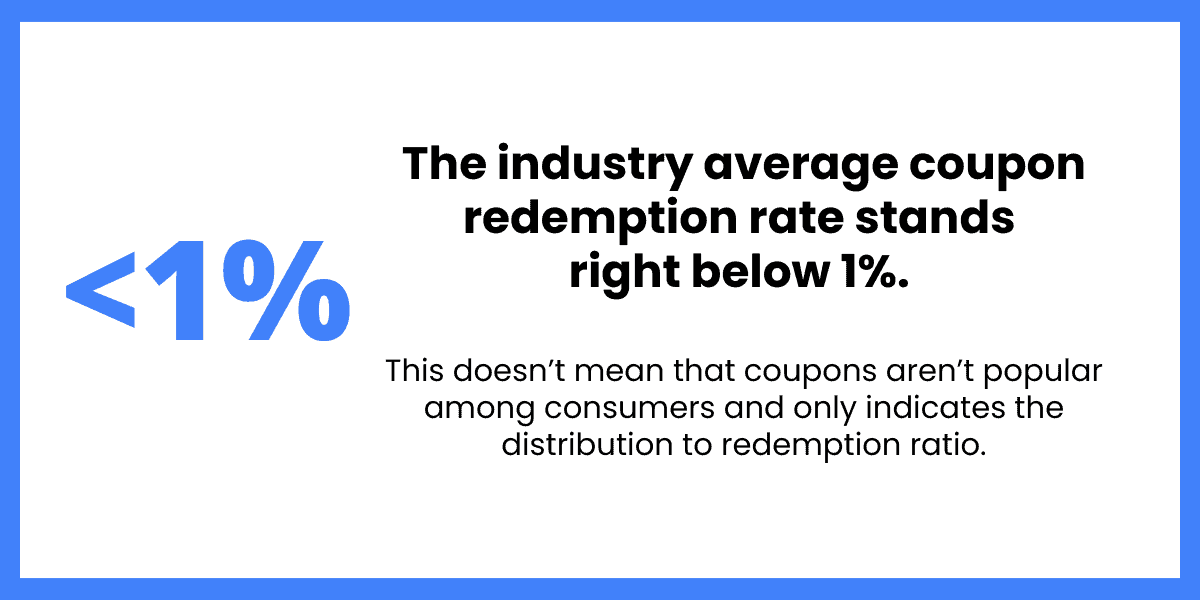
- The average coupon redemption rate in the US in 2021 was 0.77% (Statista).
- In 2019, $467 billion worth of coupons were distributed in the US. Only $3.6 billion were redeemed.
- In 2015, consumers redeemed 2.84 billion coupons out of 319 billion distributed (Inmar).
- Digital coupon redemptions surpassed paper coupon redemptions for the first time in Q2 2020.
- Digital coupon redemptions were predicted to surpass $90 billion by 2022.
Loyal Guru works with grocers to improve their coupon strategy with our offer personalization platform.
One client achieved:
- 9.98% redemption rate on upselling campaigns
- 19.58% on cross-selling campaigns with loyal customers
- 4.28% with sporadic shoppers
What are the different types of coupons?

Based on promotion type, coupons allow retailers to offer:
- Percentage-based discounts (most common)
- Free shipping, often tied to a minimum order value
- Free gifts, usually conditional on a minimum purchase
- Dollar-based offers, which increase perceived loss if unused
What consumers use coupons (by generation)
- 9 out of 10 respondents use coupons for groceries, OTC meds, household and beauty purchases.
- 89% of millennial parents use coupons when planning shopping (vs 78% without children).
- Online coupon usage nearly tripled among consumers aged 50+.
- 53% of men use online coupons vs 47% of women.
Digital coupon use by generation
| Generation | Digital Coupon Use |
|---|---|
| Parents | 92% |
| Millennial Parents | 96% |
| Millennials | 88% |
| Gen X | 83% |
| Baby Boomers | 64% |
How do shoppers want to receive their coupons (by channel)

- 45% prefer receiving grocery coupons via email.
- 93% are very likely to use coupons received via email.
- 47% rely primarily on coupon apps.
- 44% use cashback and points apps.
- Only 11% prefer social media for receiving coupons.
Number of digital coupon users (US)
| Year | Users |
|---|---|
| 2015 | 119.8M |
| 2016 | 126M |
| 2017 | 131M |
| 2020 | 142.3M |
| 2021 | 145.3M |
How do coupons influence shopping behavior?
- Almost 70% of consumers love receiving coupons.
- Online coupon users spend 24% more than regular shoppers.
- 66% would make a purchase if they had a coupon.
- 63% would reconsider an abandoned cart if offered a coupon.
- 80% would try a new brand if offered a discount.
- 68% believe digital coupons generate loyalty.
- 48% avoid brands that don’t offer deals.
Psychological triggers: Why do coupons attract shoppers?
There are 5 psychological triggers that drive coupon effectiveness.
1. Anticipation
Think Black Friday. Shoppers prepare in advance and plan purchases.
Retailers can build anticipation for loyalty launches or special campaigns to create momentum.

2. Scarcity
Limited stock or limited-time offers increase desire and urgency, especially for high-ticket items.

3. Reciprocity
When someone gives us value, we feel obligated to return it.
Free samples and trial products drive loyalty and future purchases.

4. Urgency
Expiring coupons and flash sales push customers to act immediately.

5. Likeability
Customers buy from brands they know, like and trust.
Supporting causes and humanizing the brand increases campaign effectiveness.

Can coupons be bad for a brand or retailer?
Not every brand or product responds well to discounts.
Coupons can damage perceived value — especially for luxury products.
Discounted luxury goods may be perceived as inferior or outdated.
Enterprise retailers must apply the right pricing strategy, at the right time, for the right customers.
Conclusion
Mass coupons don’t build loyalty. Customers want a personalized experience.
- 90% of people find personalization appealing.
- 80% are more likely to do business with companies offering personalized experiences.
Consumers expect:
- Recognition
- Relevant recommendations
- Context-aware offers
Your coupon management software should allow you to scale personalized offers and design millions of AI-powered promotions in minutes — not weeks.
About Loyal Guru
Loyal Guru empowers retailers to go from customer data to 1:1 personalized coupons at scale, driving results, reducing distribution costs and managing promotions efficiently.
A specialized coupon management system saves developer time, reduces costs and shortens time-to-market compared to limited or custom-built solutions.
If you are considering whether to build or buy a coupon management system, get in touch with our team — we’ll be happy to discuss your brand’s unique challenges.